


Copyright forever?
How Disney and other corporate entities have hijacked artistic protection

“To promote the Progress of Science and useful Arts, by securing for limited Times to Authors and Inventors the exclusive Right to their respective Writings and Discoveries.”
So reads the Constitution of the United States (Article I, Section 8, Clause 8), in granting Congress the power to pass laws establishing copyrights and patents. Note that it doesn’t require Congress to pass such laws - it allows for it.
The original copyright laws in this country predated the adoption of the Constitution, and were passed by state legislatures, granting authors anywhere from 14 to 21 years of the exclusive right to publish their works. After that, anyone could publish a work - much as anyone can publish a new edition of Shakespeare or the King James Bible, and not have to pay royalties. (Sites such as Project Gutenberg have digital copies of all types of works that are in the public domain, everything from Homer to Shakespeare to some of the early Tarzan titles by Edgar Rice Burroughs.)
Today, after a convoluted journey powered in large part by the legal department at Disney (with several assists by the Recording Industry Association of America), that protection stands at a remarkable 90+ years.
Interestingly, while entertainment conglomerates have gotten Congress and international bodies to extend copyright protection to well over a century before those works return to the public domain, available to anyone, patent law has remained pretty steady: Twenty years from the date you file the patent, and then your invention is public domain.
Given that the Constitution makes no differentiation between the two types of creativity, the wide disparity between the two in contemporary law is, to say the least, curious.
Are we really to believe that Samuel Clemens is deserving of and more in need of protection for his works than, say, Thomas Edison? That the next comic book or hit record is more important to the American people than a lifesaving drug?
James Madison, who was deeply involved in the writing of the Constitution, shared his thoughts about copyright and patent in an undated letter written during his post-presidential retirement:
“Monopolies tho’ in certain cases useful ought to be granted with caution, and guarded with strictness against abuse. The Constitution of the U.S. has limited them to two cases, the authors of Books, and of useful inventions, in both which they are considered as a compensation for a benefit actually gained to the community as a purchase of property which the owner might otherwise withhold from public use. There can be no just objection to a temporary monopoly in these cases: but it ought to be temporary, because under that limitation a sufficient recompense and encouragement may be given.”
So clearly the purpose of copyright was to encourage the artistic and inventive among us to create things that would benefit the whole of society.
Yet that is hardly the current situation. Rather than providing financial motivation to the creative, today’s copyright law is a bulwark against creativity - shielding massive corporations from competing visions of iconic characters. After all, why should Batman be treated differently that Robinhood?
And for the first century of our nation, there was no such great disparity.
Still, even by 1908, the term of a copyright in the United States had been extended to 42 years - double the patent protection granted an inventor.
During debate the next year about revisiting copyright law to include photography, it was noted that in European nations the standard had become the life of the author plus 50 years, to allow for the care of an author’s wife and children. The 1909 U.S. law extended the total term to 56 years.
However, the U.S. was still excluded from signing the Berne Convention providing international protection, because the global standard had become life of the author plus 50 years. In 1976, Congress adopted that standard - and then some. By 1998, the international standard had become life of the author plus 70 years, and the U.S. was compelled to update its own laws.
But it was Disney that led the lobbying for the 1976 copyright extension - as the original copyright on Mickey Mouse, the company’s iconic cartoon character, was due to expire in 1984. The 1976 law extended that copyright to 2003.
The 1998 law - again championed by Disney, with a host of other entertainment conglomerates acting as allies (the record industry in particular) - extended Mickey’s protection through the 2023 calendar year.
As this is written, the character of Mickey Mouse will enter the public domain on Jan. 1, 2024 - at which point, anyone would be free to create new Mickey Mouse cartoons, comic books, children’s books, stuffed animals, etc. We could see gay Mickey, Orthodox Jewish Mickey, hip-hop Mickey, evangelical Christian Mickey - and there wouldn’t be a thing Disney could do about it.
While estimates vary, it is clear that the Mickey Mouse character generates billions of dollars in profits for Disney each year. And while Disney still has a trademark on the Mickey Mouse image (and trademarks, as symbols of a corporation, can be renewed indefinitely), it obviously cannot trademark every possible iteration of Mickey - and trademark protections are very specific.
Further, early films featuring Mickey Mouse, such as his 1928 debut, “Steamboat Willie,” should enter the public domain in coming years, meaning anyone with a film print would be allowed to make a digital copy and sell their own DVDs or BluRays, or stream it, without having to pay royalties to Disney.
Given the tight margins in Congress, it seems unlikely Disney could get another copyright extension passed this year. European and Asian regulators are also none too happy with U.S.-based corporations right now, so it is possible that Mickey Mouse may actually finally get to live where he belongs: In the public domain.

Earlier this spring, I had a chance to chat with New York-based jazz vocalist Naama Gheber via Zoom. That interview is now published at AllAboutJazz.
Gheber is about the same age as my older children, and shares the oldest’s love for the Great American Songbook. It’s good to see yet another generation fall in love with the wonderful music of the 1920s-’50s, and carry it forward to a new set of fans.
If you like the article, say so - click on the “Like” button at the top of that page. It will help make her feel appreciated.

Paul Longworth recently reminded me of the night we spent in a graveyard looking for a satanic cult.
Paul was chief of photography at the Chula Vista Star-News in the late 1980s, and I was a reporter. The Star-News was then a twice-weekly publication (it’s once a week now), coming out on Wednesdays and Saturdays, and we lived for the rare occasion we might get a chance to scoop the San Diego dailies.
One day, I got a call from a reader telling me that he’d found pentagrams drawn on the sidewalks at the local cemetery - with wax drippings at each point. Living nearby, he’d heard odd chanting at midnight earlier in the year - and he suspected that some kind of witchcraft rituals were being held where his loved ones were interred.
I drove out to the cemetery, and quickly found the chalk pentagrams - and the wax drippings.
My editor wasn’t keen on the idea, although the thought of a headline blaring “Star-News busts satanic cult at local cemetery” finally won him over.
Paul was immediately on board, and made sure to get the right kind of film and lenses to shoot in low-light conditions.
I don’t remember a whole lot about that night - it’s been some 30 years. I do recall we timed our attempt to catch them in the act for an equinox or solstice, as that seemed a likely date to appeal to the kind of folks who draw pentagrams in cemeteries.
We got to the cemetery after dusk - I don’t remember if we had permission or just showed up. I remember being cold, and then bored, and nobody ever did show up.
It would have made a great headline if they had shown up, though.

While Janis Joplin got all the headlines and most of the airplay of the female singers in the Bay Area in the late 1960s, a good case can be made that there were other women-led bands that were more interesting.
Mother Earth and Joy of Cooking were both active and recording at the same time as Joplin, but neither ever got the kind of hype they deserved.
Mother Earth was led by blues singer Tracy Nelson, who had relocated from Madison, Wis.
Joy of Cooking was co-led by singers Terry Garthwaite and Toni Brown. Garthwaite also played guitar, and Brown piano, and both composed for the band as well.
They released three LPs from 1970-1972, then recorded two more as Toni & Terry: “Cross Country” in 1973 and “The Joy” in 1977.
After that, they established solo careers.
Their vocal harmonies together were remarkable, their songwriting strong. Never having a hit record undoubtedly stalled their careers, but that’s as much luck as anything, and several of their songs had strong enough melodic hooks to have scored chart success with a lucky break or two.
“Hush” is taken from their 1971 debut, and is a reimagined take on a traditional folk song. Brown opens the song with a block chord vamp on the melodic theme, then the two women trade vocals atop the band’s percolating rhythms.
A live version of “Too Late, But Not Forgotten,” also from their first album:
The title track to their second album, from 1971:
“All Around the Sun and The Moon” came off their third, and final studio album as Joy of Cooking, in 1972:
A year later, the two women regrouped under their own names, and released an album, “Cross Country,” that featured this song, “Midnight Blues”:
In 1977, they recorded together one last time - an album titled “The Joy.” This track is “Morning Man”:
Next week we’ll revisit Tracy Nelson.

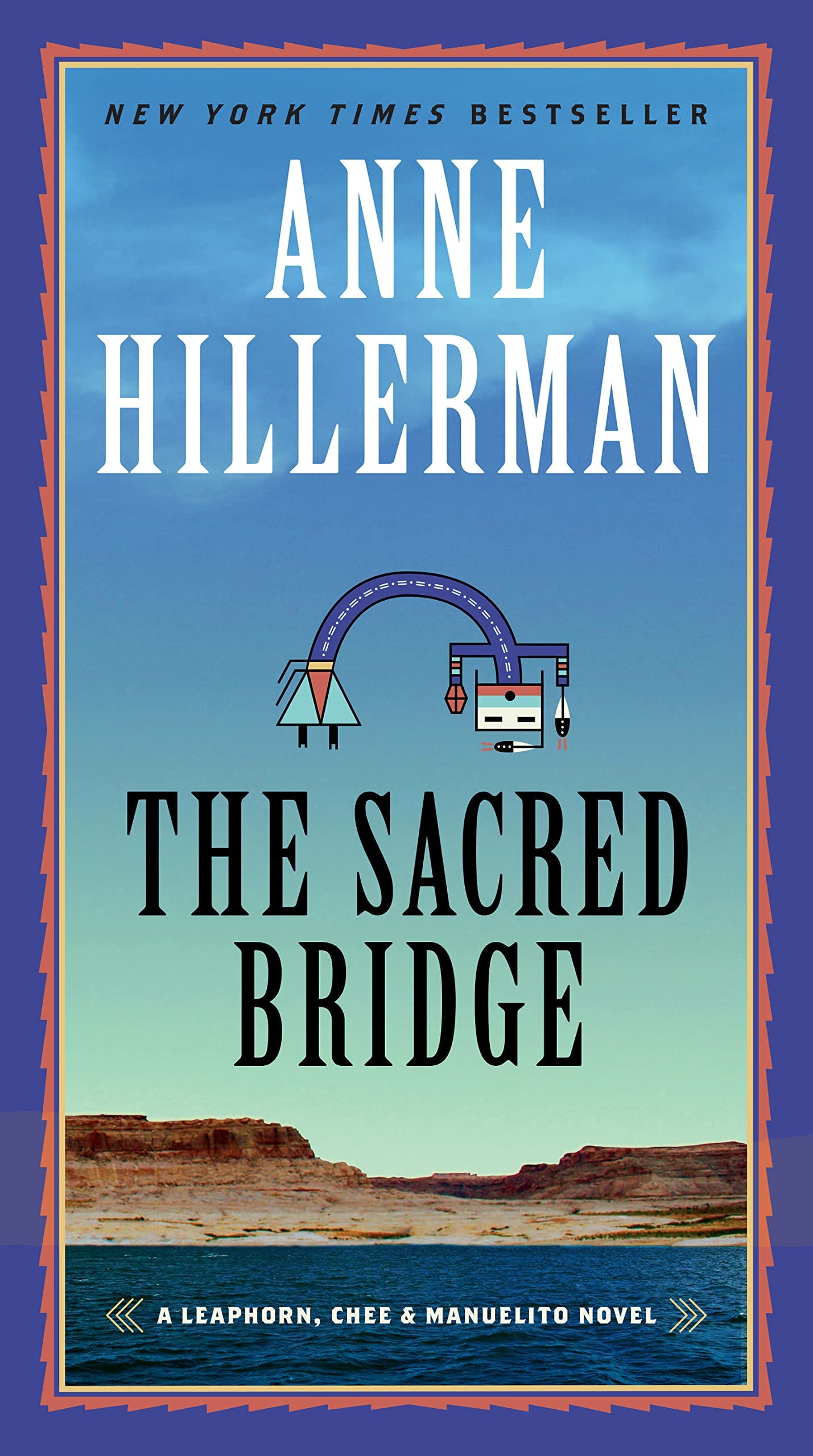
“The Sacred Bridge,” by Anne Hillerman
Anne Hillerman’s 8th novel in her continuation of her father’s Navajo police mysteries is like a too-short visit with old friends, where you utterly enjoyed the time together but are already looking forward to the next visit.
Detective Jim Chee is on vacation by Lake Powell when he comes across a corpse floating in the lake - and agrees to the park ranger’s request to stay on a few more days and lend a hand with the investigation.
Meanwhile, back at home, Chee’s wife, Bernadette Manuelo, witnesses a vehicular homicide on her day off - an Asian man runs up to her car asking for help before he is brutally run down twice by a Mercedes with blacked out windows, which then takes off while she tends to the mortally wounded victim.
While Chee tries to narrow down the list of suspects who might have wanted to kill the seemingly well-liked Navajo man whose body he found, Berne talks Captain Largo into letting her go undercover at a new hemp plant on the Navajo Nation that may not be what it’s administrators claim.
The Jim Chee arc is classic Hillerman, and has Chee wondering if he should resume his aborted studies to become a traditional healer. He also is working on an angle for his mentor, the retired Lt. Joe Leaphorn.
The Bernie arc feels a bit like a Jack Reacher novel - with the large, isolated industrial plant run by mysterious figures terrorizing the neighbors.
There are a few disjointed passages that her editors should have caught: When Chee calls the local sheriff’s deputy late in the book, he’s on the phone with the deputy - then suddenly they’re in her office? And there are a surprising number of typos, particularly for a publishing house the size of Harpers.
But those are minor quibbles about another strong entry in this series.
And I fully realize that Chee and Bernie should be way too old to be talking about starting a family, that Captain Largo should have hit mandatory retirement decades ago, that Leaphorn would, based on his being 40 in the first novel 52 years ago, be 92.
At the same time, this is all fiction, and they’re not stuck in stasis - they’re just aging slowly.
And I’m okay with that. I’m in no hurry to have to say goodbye to these friends.
-30-